
Ranch Estates
& Family Compounds
Built to Last Generations
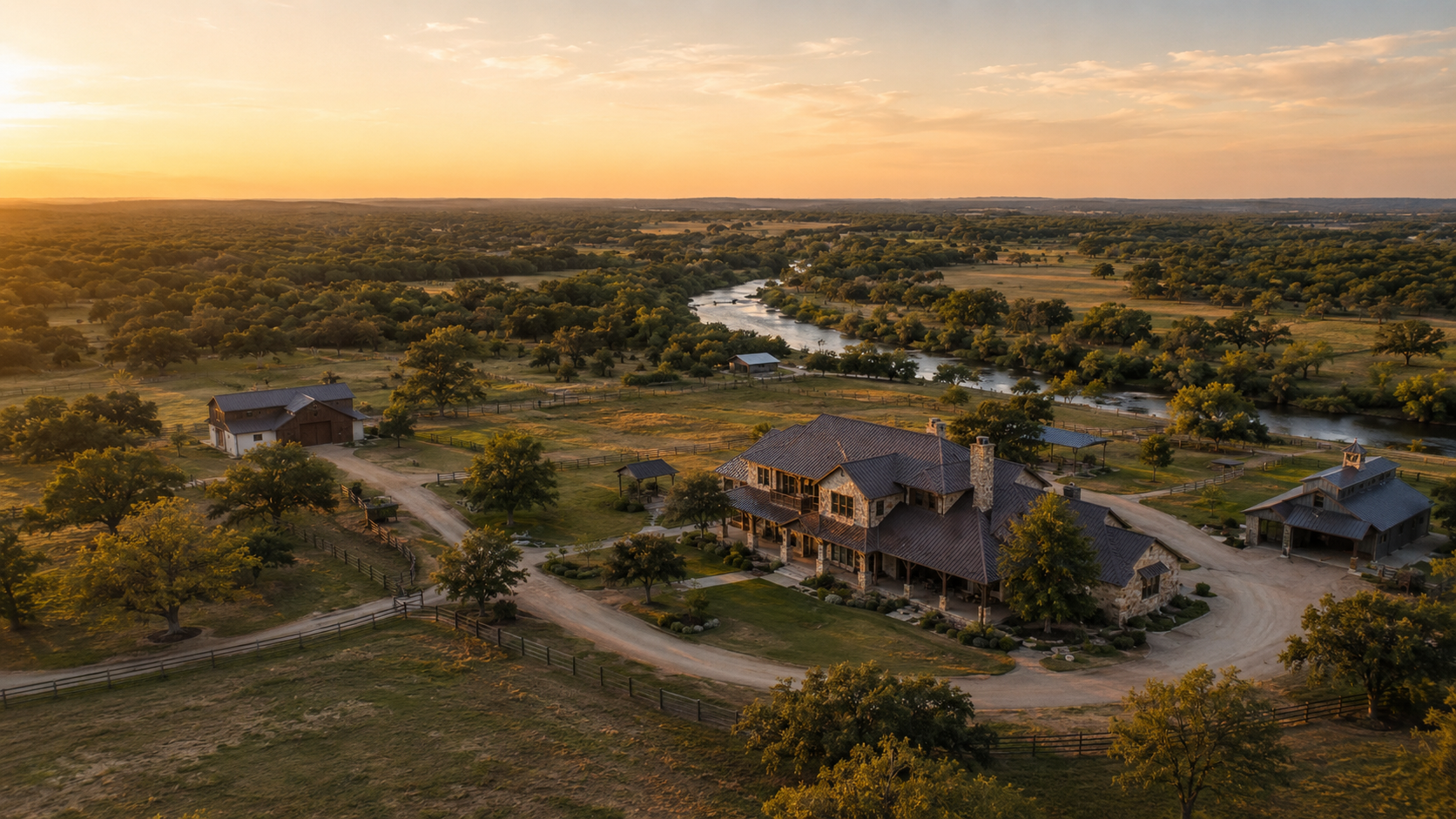
A place your family will never want to leave. Primary residence, guest houses, barns, and outdoor living, designed and built as one legacy compound. For owners of large acreage building for the next generation.
One Place.
Many Buildings.
One Plan.
A ranch estate is not a series of separate jobs, the main house, then the guest house, then the barn, then the pool. We design the whole compound as one coordinated project so it ages well, reads as one place, and serves the way your family actually uses it.
Our clients are families building for the long term, owners of working ranches who want a primary residence that fits the land, and second-generation buyers turning legacy property into a family seat. Every project gets the direct attention of our principals from the first site walk to the final walk-through.
In Texas and beyond, when the project is right.
The counties above are where we have recent and active ranch work, not the limits of where we will build. Woolsey takes on selective ranch and family compound projects in Texas and beyond, when the project is right. Tell us about your land and we will tell you honestly whether we are the right team for the job.
Start the Conversation →What Makes a
Woolsey Estate Different
Built for the Long View
Ranch estates are not weekend projects. We build for the way the land changes over decades, the way a family grows, and the way a property gets passed down. Every decision is made with the next 30 years in mind.
Coordinated, Not Stacked
A primary residence, guest houses, barns, equestrian facilities, and outdoor living spaces should feel like one place, not a series of bolt-ons. We design and build the whole compound as a single coordinated project.
Real Acreage Experience
Building on 50, 200, or 500 acres is a different discipline. Wells, septic, long utility runs, road grading, drainage across uneven terrain, every one of these matters more on big land than on a small lot. We have done this work for years.
Two Offices, One Standard
Our New Braunfels and Fredericksburg offices give us real coverage across the eastern and western Hill Country. Wherever your land is, you have a team within reach, and the same standard of construction either way.
Ranch Estates and Family Compounds: Common Questions
Can you build a family compound in Texas?
Yes, and the Texas Hill Country is one of the easier places in the country to do it, because outside city limits the county does not zone land and does not limit how many houses a family puts on one tract. What governs a compound instead is infrastructure and paperwork. In the counties Woolsey builds ranch estates in, the county permits the sewage system and floodplain development and a groundwater district registers or permits the well; none of them issues a general building permit outside a city. Every dwelling with plumbing adds to the sewage load, so the system is designed for the whole compound, not the first house. One well may or may not carry three households, and the groundwater district's rules decide what a second well would need. If the family intends to split the land among members, the county's subdivision rules come into play. And a deed restriction or an architectural committee can limit what the county does not. Woolsey plans the compound as one site plan, with the utilities, drives, and drainage laid out for every building at once, even when the buildings go up over several years.
How much would a family compound cost in Texas?
No honest builder can put a number on that without a site and a plan, and we will not. What we can tell you is what drives it around the Texas Hill Country. The number of dwellings matters less than people expect; the infrastructure that serves them matters more. on Hill Country ranch land that means a well the groundwater district will register or permit, a sewage system approved for every dwelling on the property, a road cut and held across the terrain, and utility runs across whatever distance separates the buildings. A compound shares one driveway, one set of utility runs, one drainage plan, and usually one water source, and the distance between the buildings sets the cost of every one of those. A main house and two guest houses clustered near the road cost a fraction of the same three buildings spread across a ridge. Then each building carries its own size and finish level. Phasing changes the cash flow but not the total, and building the infrastructure for the whole plan on day one is almost always cheaper than trenching the property twice. We build the budget for the full compound before the first house is designed, so the family knows what the whole plan costs, not just the first phase.
Can I legally build my own house in Texas?
Yes. Texas does not license general contractors at the state level, so a property owner can act as their own builder. That is the legal answer; the practical one is longer. Outside city limits, the Hill Country counties do not issue a general building permit, but each requires the sewage system to be designed and approved, a floodplain permit where the map calls for it, and a driveway permit at a county road, and the groundwater district has to register or permit the well; an owner-builder carries every one of those. State law also sets the International Residential Code as the standard for new single-family construction in the unincorporated areas it covers, with inspections at the foundation, framing, and completion stages, and the sewage system has to be designed and approved by the county regardless of who is building. An owner-builder carries all of that, plus scheduling and paying every trade, plus the risk on every decision. Some people do it well. Most people who call Woolsey have decided that the coordination, the pricing, and the accountability are what they are hiring, and that the house is the result.
How big of a structure can I build without a permit in Texas?
It depends entirely on who has jurisdiction over the lot. Inside a city's limits, the city's adopted building code sets the threshold, and most codes exempt only a small one-story accessory building; a house is never exempt. Outside the city limits it is a different question, because the Hill Country counties do not issue a general building permit in their unincorporated areas; they permit the sewage system, floodplain development, and the driveway connection to a county road, whatever the size of the building. What that means in practice is that the size of the building is rarely what triggers a permit in the county. A barn, a guest house, or a workshop can go up without a county building permit and still require a sewage permit if it has plumbing, a floodplain permit if it sits in a mapped flood area, and a driveway permit if it gets a new approach from a county road. A deed restriction or an architectural committee can add rules of its own. We map all of that for the specific parcel before we tell anyone what they can build.
Let's Talk About
What You're Building
Whether you're in the early stages of a concept or ready to break ground, we'd love to hear about your project. Request a consultation and we'll walk through your vision, share what we're seeing in the market, and help map out a clear path forward.
New Braunfels (HQ)
2111 S I-35 South Frontage Rd
Suite 2110, New Braunfels, TX 78130