
Legacy Custom Homes
Built to Last Generations
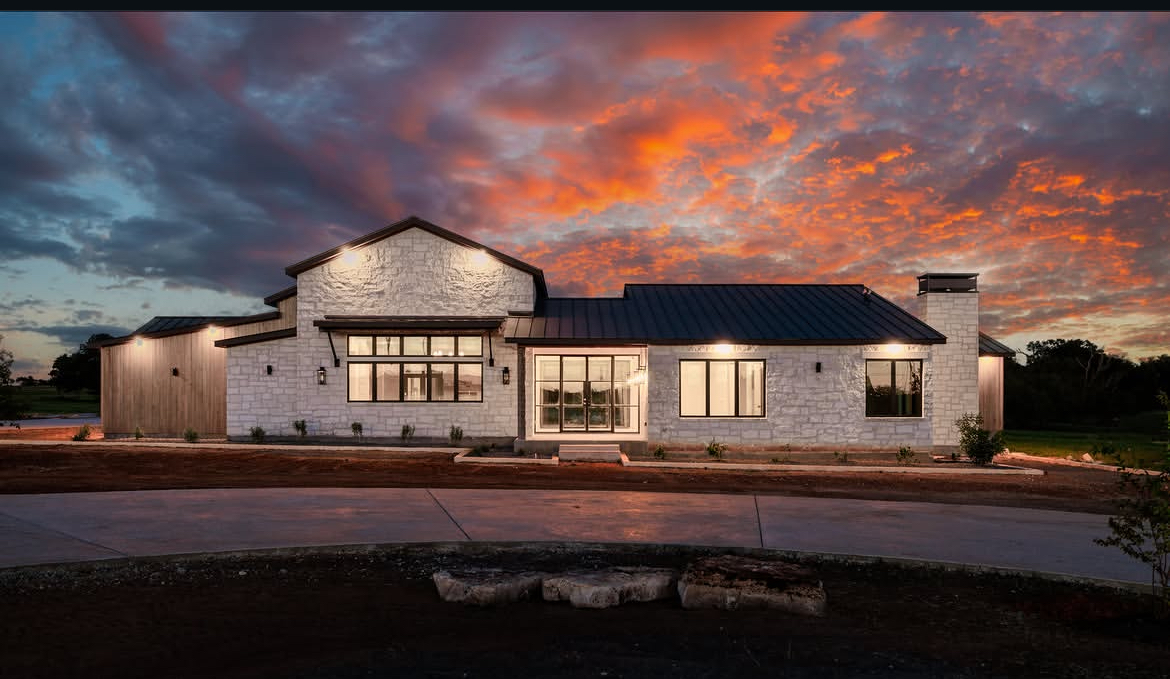
We build a small number of custom homes each year for clients who care about how a place ages. Designed for the land, built with the craft to last, and shaped around the way you actually want to live.
A Legacy Approach to
Custom Homebuilding
We are not a volume builder. We partner with a small number of clients each year who are looking for a highly personal, detail-driven custom home experience.
Our clients are owners, investors, and families who want a home that is thoughtfully designed for the land, built with the craftsmanship to last generations, and managed by a team that treats their investment like it matters. That's the standard we hold ourselves to on every project.
If you are considering a custom home, call us before you make a move.
The areas above are where we have recent and active work, not the limits of where we will build. Woolsey takes on legacy custom-home projects in Texas and beyond, when the project is right. Tell us where you are building and we will tell you honestly whether we are the right team for the job.
Start the Conversation →What Makes a
Woolsey Home Different
Legacy by Design
We limit the number of custom homes we build each year so your project receives the direct attention of our principals and senior team from start to finish.
Design-Build Under One Roof
We strive to bring excellence on every single stage of the design phase. We lead the process with experience, ensuring feasibility, accurate costing, efficient schedules, and prompt communication between all parties.
Building Here Since 2006
Woolsey was founded in 2006 and the team brings 25+ years of experience to the work. We know this land: the limestone, the terrain, the wells, the county rules, and the communities. That knowledge shows up as better designs, sound construction, and homes that belong where they stand.
Preconstruction Advisory
Before you hire an architect or finalize a land purchase, talk to us. We help you understand what a site can support and what it will cost to build, before you commit capital.
Building a Custom Home: Common Questions
What is the average cost to build a custom home in Texas?
There is no honest single number, and a builder who gives one on a website is guessing. What we can tell you is what moves the cost on a Texas Hill Country site, in order of how often it surprises people. The land itself comes first, and then what the land needs before a foundation can be poured: outside a city's limits that means a sewage system designed for the house and approved by the county, a well or a water tap, a floodplain check, and a driveway permit at the county road, and on most of the Hill Country's limestone it means rock excavation and a foundation engineered for the slope. Then the house: its size, how much of it is glass and steel versus framed wall, the finish level inside, and how much outdoor living it carries. Two homes of the same square footage can be far apart in price on those choices alone. What Woolsey does about it is build the budget before the design is finished, so the number you commit to is one that already accounts for the site and the finishes you actually chose, rather than one that grows after the contract.
Is it cheaper to buy or build a house in Texas?
It depends on what is for sale, and in the Texas Hill Country the honest answer changes with the market. Buying an existing home is usually faster and the price is known on day one. Building lets you choose the site, the layout, the materials, and the systems, and it means nothing in the house is someone else's compromise. On raw land, building carries costs that a resale does not: a well or water tap, a sewage system, the driveway, the utility runs, and the site work a rocky lot demands, and those have to be in the comparison or it is not a fair one. Where building tends to win is when the home you want does not exist on the market, or when the land you want is only available as land. Where buying tends to win is when a well-built home on the right site is already for sale. We will tell you which one we think applies to you, including when the answer is to buy.
Can I legally build my own house in Texas?
Yes. Texas does not license general contractors at the state level, so a property owner can act as their own builder. That is the legal answer; the practical one is longer. Outside city limits, the counties Woolsey builds in do not issue a general building permit, but each requires the sewage system to be designed and approved, a floodplain permit where the map calls for it, and a driveway permit at a county road, and the groundwater district has to register or permit the well; an owner-builder carries every one of those. State law also sets the International Residential Code as the standard for new single-family construction in the unincorporated areas it covers, with inspections at the foundation, framing, and completion stages, and the sewage system has to be designed and approved by the county regardless of who is building. An owner-builder carries all of that, plus scheduling and paying every trade, plus the risk on every decision. Some people do it well. Most people who call Woolsey have decided that the coordination, the pricing, and the accountability are what they are hiring, and that the house is the result.
How big of a structure can I build without a permit in Texas?
It depends entirely on who has jurisdiction over the lot. Inside a city's limits, the city's adopted building code sets the threshold, and most codes exempt only a small one-story accessory building; a house is never exempt. Outside the city limits it is a different question, because the Hill Country counties do not issue a general building permit in their unincorporated areas; they permit the sewage system, floodplain development, and the driveway connection to a county road, whatever the size of the building. What that means in practice is that the size of the building is rarely what triggers a permit in the county. A barn, a guest house, or a workshop can go up without a county building permit and still require a sewage permit if it has plumbing, a floodplain permit if it sits in a mapped flood area, and a driveway permit if it gets a new approach from a county road. A deed restriction or an architectural committee can add rules of its own. We map all of that for the specific parcel before we tell anyone what they can build.
Let's Talk About
What You're Building
Whether you're in the early stages of a concept or ready to break ground, we'd love to hear about your project. Request a consultation and we'll walk through your vision, share what we're seeing in the market, and help map out a clear path forward.
New Braunfels (HQ)
2111 S I-35 South Frontage Rd
Suite 2110, New Braunfels, TX 78130